DCDC Poster Symposium

On May 1, 2013, students engaged in DCDC education programs participated in our annual poster symposium. Graduate students from the Community of Graduate Scholars program, undergraduate interns from the Internship for Science-Practice Integration program, and undergraduates working with faculty researchers as Research Experiences for Undergraduates (REU’s) presented their research results.

CGS Posters

Farmers’ Resilience to Socio-Ecological Change in Central Arizona [poster]
- Julia C. Bausch (CGS), Cathy Rubiños, Hallie Eakin, Abigail York, and Rimjhim Aggarwal

Quenching our Thirst: Future Scenarios of Water in Phoenix [poster]
- Lauren Withycombe Keeler (CGS), Arnim Wiek, Dave White, Ray Quay, David Sampson, and John Quinn

Fostering Perspective-Taking in Collaborative Decision Making through an Interactive Computer Simulation [poster]
- Rashmi Krishnamurthy (CGS), Erik W. Johnston, Manikandan Vijayakumar (CGS), and Ajay Vinze

Actual vs. Perceived Amounts of De facto Wastewater Reuse in the Continental United States [poster]
- Jacelyn Rice (CGS) and Paul Westerhoff

Cross-cultural Perspectives on Uncertainty in Climate Science: Preliminary Results from DCDC and the Global Ethnohydrology Study [poster]
- Jose Rosales Chavez (CGS), Amber Wutich, Dave White, Kelli Larson, and Alexandra Brewis

Uncertainty Frames in Water Policy Debates [poster]
- Dave White and V. Kelly Turner (CGS)

Sustainability, Collaboration and Uncertainty: A Scenario Based Evaluation of Water Issues for Desert Cities Using Computer Simulation [poster]
- Manikandan Vijayakumar (CGS), Erik Johnston, Rashmi Krishnamurthy (CGS), and Ajay Vinze

Using Structured Discussions to Explore Cross-Cutting Themes in Research at the Decision Center for a Desert City – Community of Graduate Scholars Group Poster [poster]
- Julia C. Bausch, Jacelyn Rice, Jose Rosales Chavez, Lauren Withycombe Keeler, Rashmi Krishnamurthy, Rebecca Neel, Jorge Cazáres Rodriguez, V. Kelly Turner, and Manikandan Vijayakumar

ISPI_Spring2013_2_300

ISPI Posters

Residential Landscaping Decisions and Water Usage in the City of Phoenix [poster]
- Emily Allen, ISPI Intern with the City of Phoenix
- Doug Frost, Mentor, City of Phoenix
- Elizabeth Wentz, ASU Faculty Mentor

Analysis of Water Consumption Trends in the City of Goodyear [poster]
- Christopher Berg, ISPI Intern with the City of Goodyear
- Mark Holmes, Mentor, City of Goodyear
- Ray Quay, ASU Faculty Mentor

Implementation of Low Impact Development Paving Strategies in Central Arizona [poster]
- Erin Brechbiel, ISPI Intern with the University of Arizona Cooperative Extension
- Summer Waters, Mentor, U of A Cooperative Extension
- Abigail York, ASU Faculty Mentor

Potential Attributes of Water Use Variation in Mixed Use Residential Landscapes [poster]
- Joseph Hennessy, ISPI Intern with the City of Phoenix
- Douglas Frost and Adam Miller, Mentors, City of Phoenix
- Dave White, ASU Faculty Mentor

Modeling Well Specific Pumping at the Provider Level [poster]
- Taylor Ketchum, ISPI Intern with Arizona Department of Water Resources
- Dale Mason and Frank Corkhill, Mentors, Arizona Department of Water Resources
- David Sampson, ASU Faculty Mentor

SamKohlwey_DCDCPosterSymposium_2013Criteria-Based Risk Assessment for Sustainable Water Quality in Municipal Wells [poster]
- Samantha Kohlwey, ISPI Intern with the City of Mesa
- Brian Draper and Colette Moore, Mentors, City of Mesa
- Ray Quay, ASU Faculty Mentor

Complexities of Analyzing the Water/Energy Nexus in Small Hillside Water Distribution Systems [poster]
- Winnie (Ching Yan) Lau, ISPI Intern with the City of Phoenix
- Andy Terrey, Mentor, City of Phoenix
- Benjamin Ruddell, ASU Faculty Mentor

Effective Engagements at the Rio Salado Habitat Restoration Area [poster]
- Martin Montes de Oca, ISPI Intern with the University of Arizona Cooperative Extension
- Summer Waters, Mentor, University of Arizona Cooperative Extension
- Monica Elser, ASU Faculty Mentor

Effectiveness of the Modified Field Trip Curriculum: Teaching the Importance of Good Conservation Habits [poster]
- Andrew Wittig, ISPI Intern with Audubon Arizona
- Lyana Guevara, Mentor, Audubon Arizona
- Joni Adamson and Monica Elser, ASU Faculty Mentors

REU Posters

When Scientists Disagree: How We Frame Uncertainty Influences Public Trust of Science [poster]
- Rebecca Neel, Nicholas Murtha (REU), Susan Ledlow, Steven Neuberg, and Douglas Kenrick

The Future of Water in the Desert: Convergence and Divergence between Decision Makers and Students [poster]
- John Quinn (REU), Dave White, Lauren Withycombe Keeler, Arnim Wiek, and Kelli Larson

The Upside of Flip-Flopping: How Former Skeptics Can Shift Public Opinion on Climate Change [poster]
- Megan Ringel (REU), Rebecca Neel, Jaimie Krems, and Steven Neuberg

April 23 Water/Climate Briefing

The Future of Arizona’s Forests: Anticipating the effects of climate change and fire on water sustainability

Arizona’s forests are not only mountain playgrounds for recreation and tourism but also sustain critical ecosystem functions such as water storage, filtration, and release for downstream uses.

In the face of climate change, forest ecosystems are being stressed from higher temperatures and lower precipitation, making them more vulnerable to insect infestations and more frequent and intense wildfires.

The impacts of climate and landscape changes and wildfire include increased erosion, sedimentation, and warmer water temperatures, which in turn affect municipal water supplies and riparian habitats.

Please join us as we explore the critical research and policy priorities regarding the interaction between Arizona’s climate, forests, and water.

Panelists

Erik Nielsen
Assistant Professor
School of Earth Sciences and Environmental Sustainability
Northern Arizona University

Thomas Sisk
Olajos-Goslow Professor of Environmental Science and Policy
Northern Arizona University

Abe Springer
Professor of Geology
Northern Arizona University

Dave White
Moderator and Co-Director
Decision Center for a Desert City
Arizona State University

When

Tuesday, April 23, 2013, 12:00-1:30 p.m.
Lunch will be served. Please RSVP to: Sarah.Jones.2@asu.edu

Location

Decision Center for a Desert City, 21 East 6th Street, Suite 126B, Tempe [Map]

WCB_Apr23_2013_225

Dirks appointed director of ASU’s Global Institute of Sustainability

img_3545-1_gary_dirks_264Gary Dirks, director of Arizona State University’s LightWorks Initiative and former president of BP China and BP Pacific-Asia, has been appointed director of ASU’s Global Institute of Sustainability (GIOS), with the goal of expanding the global impact of ASU.

“GIOS’s charter is to advance research, education, business practices and global partnerships that aid in the transformation of today’s world into a more sustainable endeavor,” said ASU President Michael Crow. “With the appointment of Gary Dirks as director of GIOS, we look to increase the global impact of our work and surge ahead as a leader in sustainability.”

Dirks was chosen for this role to help GIOS solve global sustainability challenges. Dirks is a distinguished sustainability scientist, Julie Ann Wrigley Chair of Sustainable Practices, and teaching faculty member in the School of Sustainability at ASU.

“Gary possesses exactly the combination of skills, experience and intellectual curiosity to lead the Institute,” said Julie Ann Wrigley, co-chair of the GIOS Board of Directors. “As a former global business executive, member of the GIOS Board of Directors and leader of ASU LightWorks Initiative, a better leader could not have been chosen at this point in the development of the Institute.”

While in China, Dirks grew the BP operation from 30 employees and no revenue in 1995 to more than 1,300 employees and revenues of about $4 billion in 2008.

“Gary has demonstrated his ability to set a grand vision, align projects and people around that vision to create solutions to grand challenges that impact our society,” said Sethuraman “Panch” Panchanathan, senior vice president for ASU’s Office of Knowledge Enterprise Development. “He does all of this in a rapid time frame that is consistent with the spirit of the New American University.”

As director, Gary will chair the GIOS 3-person Directorate. The Directorate oversees the Insititute’s complex, pan-university mission and consists of the director, an executive dean and the dean of the School of Sustainability.

Dirks received his doctorate in chemistry from ASU in 1980, and after working in the energy industry, returned to ASU to lead the LightWorks in 2009. The LightWorks Initiative is ASU’s multidisciplinary research effort to harness the energy of sunlight and apply it across a broad spectrum of technology related challenges. Dirks will continue to lead the initiative as part of his new role at GIOS.

Dirks previously served as chairman of the British Chamber of Commerce in Beijing and as the only foreign member of the British Prime Minister’s China Task Force. He was a founding director of the China Business Council for Sustainable Development, past chairman of the China U.S. Center for Sustainable Development and served as a board member of the India Council for Sustainable Development.

In 2003 Dirks received China’s “Friendship Award,” the highest recognition granted to foreign citizens, and was appointed Companion of the Order of St. Michael and St. George from the UK in 2005. In December 2008, he was recognized by the People’s Daily as one of the 10 most influential multinational company leaders of the last 30 years of China’s economic development.

“GIOS is an extraordinary place with people who understand sustainability at a very deep level and who know how to apply sustainability concepts to solve real-world problems,” said Dirks. “The challenge for me will be building on a very strong foundation to extend the reach and impact of the Institute.”

via Amelia Huggins, Office of Knowledge Enterprise and Development, ASU

DCDC on Vimeo and Twitter

DCDC_Vimeo

Using social media, DCDC is reaching out to the public presenting ideas from experts and community partners on such topics as urban heat island, water re-use, and the energy-water nexus to name a few.

DCDC Water/Climate Briefings are on Vimeo. If you were unable to attend our latest Water/Climate Briefing or would like an opportunity to watch the Water/Climate Briefing again, check out all five of our 2012-2013 Water/Climate Briefings.

Follow us on Twitter for the latest news about DCDC, ASU, water, urban climate adaptation, and sustainability. The list goes on and on! Check us out @DCDC_ASU.

Decision Center for a Desert City at AAAS 2013

DCDC_CGS_2012-2013A contingent of faculty, graduate students and undergraduate students from the Decision Center for a Desert City (DCDC) at Arizona State University will present their research at a special poster session at the American Association for the Advancement of Science (AAAS) Annual Meeting in Boston, MA on February 17. Dave White, DCDC’s Director and Principal Investigator and Margaret Nelson, DCDC Co-PI and education program coordinator, will accompany the group.

Students from DCDC Community of Graduate Scholars (CGS) have organized a special section for the AAAS general poster session focused on decision making under uncertainty (DMUU) since 2011. The ASU students coordinated with students and faculty from universities that host projects funded by the National Science Foundation under the NSF’s DMUU program, which, along with ASU, includes Columbia University, Carnegie Mellon University and University of Chicago. The DCDC students and their faculty mentors will present research that employs interdisciplinary social science methods to develop knowledge and tools for water sustainability and climate change adaptation in urban areas. Two undergraduate students funded under DCDC’s Research Experience for Undergraduates (REU) program will also attend.

According to Margaret Nelson, an anthropologist and Vice Dean of Barrett, The Honors College, “The students in the Community of Graduate Scholars represent multiple disciplines, including psychology, anthropology, public policy, sustainability, computer science and geography. Through the seminar, students become familiar with the issues, perspectives, and language of the researchers within DCDC, as well as with issues that emerge from interdisciplinary collaborations.”

“The CGS students have not only been instrumental in developing interdisciplinary collaborations at ASU, but have fostered cooperation between the DMUU centers,” says White, a Senior Sustainability Scientist at ASU’s Global Institute of Sustainability. “Their efforts have helped develop a network of research efforts focused on improving environmental decision making.”

Research posters will be presented by the following students:

  • Rebecca Neel, CGS, Using upward trends to promote sustainable behaviors. [Poster]
  • Nicholas Murtha, REU, (Rebecca Neel 1st author), When scientists disagree: How we frame uncertainty influences public trust of science. [Poster]
  • Lauren Withycombe Keeler, CGS, Quenching our thirst: Future scenarios of water in Phoenix. [Poster]
  • V. Kelly Turner, CGS (Dave White 1st author), Uncertainty frames in water policy debates. [Poster]
  • Rashmi Krishnamurthy, CGS, Fostering perspective-taking in collaborative decision making through an interactive computer simulation. [Poster]
  • Jose Rosales Chavez, CGS, Cross-cultural perspectives on uncertainty in climate science: Preliminary results from DCDC and the Global Ethnohydrology Study. [Poster]
  • Julia C. Bausch, CGS, Farmers’ Resilience to Socio-Ecological Change in Central Arizona. [Poster]
  • Manikandan Vijayakumar, CGS, Sustainability, Collaboration and Uncertainty: A Scenario-­‐based Evaluation of Water Issues for Desert Cities Using Computer Simulation. [Poster]
  • Jacelyn Rice, CGS, Actual vs. perceived amounts of de facto wastewater reuse in the Continental United States. [Poster]
  • John Quinn, REU, The future of water in the desert: Convergence and divergence between decision makers and students. [Poster]

The AAAS is an international non-profit organization dedicated to advancing science around the world by serving as an educator, leader, spokesperson and professional association.

The Decision Center for a Desert City (DCDC) at Arizona State University (ASU) was established in 2004 by the National Science Foundation (NSF) to advance scientific understanding of environmental decision making under conditions of uncertainty.

DCDC Research Highlights from Recent Poster Symposia

DCDC researchers shared their research at several conferences and meetings in the first half of the 2012-2013 academic year. From topics ranging from The Social Ecology of Residential Land Management to An Application Programmer’s Interface (API) to WaterSim: WaterSim 5.0, DCDC’s interdis­ciplinary research projects form a broad effort to inform urban decision makers about the evolving challenges of coping with a changing climate.

Jose Rosales Chavez, DCDC Graduate Research Assistant

Our researchers participated in the following poster symposia:

  • 15th Annual CAP LTER Poster Symposium and All Scientist Meeting, Scottsdale, AZ, January 11, 2013
  • American Geophysical Union Fall meeting, San Francisco, CA, December 3-7, 2012
  • PhD Design, Environment, and the Arts Student Research Poster Exhibit and Reception, Tempe, AZ, October 4, 2012
  • Long-Term Ecological Research All Scientist Meeting, Estes Park, Colorado, September 12, 2012

Larson, K.L., E. Cook, J. Brumand, S. Hall, and K. Feldbauer. 2013. The social ecology of residential land management: Complex effects, tradeoffs and legacies in the Sonoran Desert of Phoenix, AZ. Poster presented at the 11 January 2013, 15th Annual CAP LTER Poster Symposium and All Scientist Meeting 2013, Skysong, Scottsdale, AZ.

Larson, K.L. 2012. The social ecology of residential land management: Complex effects, tradeoffs and legacies in the Sonoran Desert of Phoenix, AZ. Presented September 12, 2012, at the Long-Term Ecological Research All Scientist Meeting, Estes Park, CO, September 10-13.

Ariane Middel, Ph.D., DCDC Post Doctoral Scholar

Middel, A., K. Häb, A.J. Brazel, C. Martin, and S. Guhathakurta. 2013. Impact of urban form and design on mid-afternoon microclimate in Phoenix neighborhoods . Poster presented at the 11 January 2013, 15th Annual CAP LTER Poster Symposium and All Scientist Meeting 2013, Skysong, Scottsdale, AZ. [Poster]

Middel, A., K. Häb, J.P. Erickson, A.J. Brazel, C. Martin, and S. Guhathakurta. 2012. Impact of microclimate on residential energy consumption in different Phoenix Arizona neighborhood types. Poster presented on October 4, 2012 at the PhD Design, Environment, and the Arts Student Research Poster Exhibit and Reception, Tempe, AZ.

Moreno, H., E. Vivoni, and D. Gochis. 2012. Exploring the limits of flood forecasting in mountain basins by using QPE and QPF Products in a physically-based, distributed hydrologic model during summer convection. Poster presented December 6, 2012 at the American Geophysical Union Fall meeting, December 3-7, 2012, San Francisco, CA. [Poster]

Quay, R., D. Sampson, D. White, C. Kirkwood, and P. Gober. 2013. Using advanced scenario analysis as an anticipatory tool: Exploring the uncertainty of urban water demand and supply within Central Arizona. Poster presented at the 11 January 2013, 15th Annual CAP LTER Poster Symposium and All Scientist Meeting 2013, Skysong, Scottsdale, AZ. [Poster]

Jacelyn Rice, DCDC Graduate Research Assistant

Rice, J., and P. Westerhoff. 2013. Indirect potable reuse in the Phoenix metropolitan area: How much wastewater is in Central Arizona-Phoenix source waters? Poster presented at the 11 January 2013, 15th Annual CAP LTER Poster Symposium and All Scientist Meeting 2013, Skysong, Scottsdale, AZ. [Poster]

Rosales Chavez, J., A. Wutich, A. Brewis, A.M. York, and R. Stotts. 2013. Rules, norms, and injustice: A cross-cultural study of perceptions of justice in water institutions. Poster presented at the 11 January 2013, 15th Annual CAP LTER Poster Symposium and All Scientist Meeting 2013, Skysong, Scottsdale, AZ. [Poster]

Sampson, D.A., and R. Quay. 2013. Potential Central Arizona Project water shortages as influenced by climate and Upper Basin delivery schedules. Poster presented at the 11 January 2013, 15th Annual CAP LTER Poster Symposium and All Scientist Meeting 2013, Skysong, Scottsdale, AZ. [Poster]

Sampson, D.A., and R. Quay. 2012. An Application Programmer’s Interface (API) to WaterSim: WaterSim 5.0. Poster presented December 5, 2012 at the American Geophysical Union Fall meeting, December 3-7, 2012, San Francisco, CA. [Poster]

Transitions in Urban Environmental Systems: Lessons from New York City and Hurricane Sandy

DCDC is proud to co-sponsor the 15th Annual CAP LTER Poster Symposium keynote speaker, William Solecki, Director of the Institute for Sustainable Cities, and Professor, Department of Geography at City University of New York, at this year’s Poster Symposium and All Scientists Meeting.

On Friday, January 11, 2013, Dr. Solecki will be presenting “Transitions in Urban Environmental Systems: Lessons from New York City and Hurricane Sandy.” In this talk, he will reflect on the past urban environmental system crises and transitions. The lens of critical transition theory and writings on urban system resilience can be used to sharpen our analytical capacity to study such issues.

The agenda includes invited presentations on representative current research in the Central Arizona-Phoenix Long-Term Ecological Research program. There will also be two interactive poster sessions featuring 60 posters from a variety of CAP LTER research and education projects, including exhibits from high school and middle school students participating in the Ecology Explorers program.

Special working sessions to discuss future research in the areas of water, climate, biodiversity, biogeochemistry, and CAP’s foundational databases are planned for lunchtime. An RSVP is required to participate in these working sessions, at which lunch will be provided.

The Convergence Room at SkySong is in the northeast corner of the building. There is free parking north of the building, and SkySong is also accessible by Valley Metro (bus 72) from the Tempe Transit Center.

Colorado River Basin Water Supply & Demand Study

December 12, 2012 – via the Bureau of Reclamation

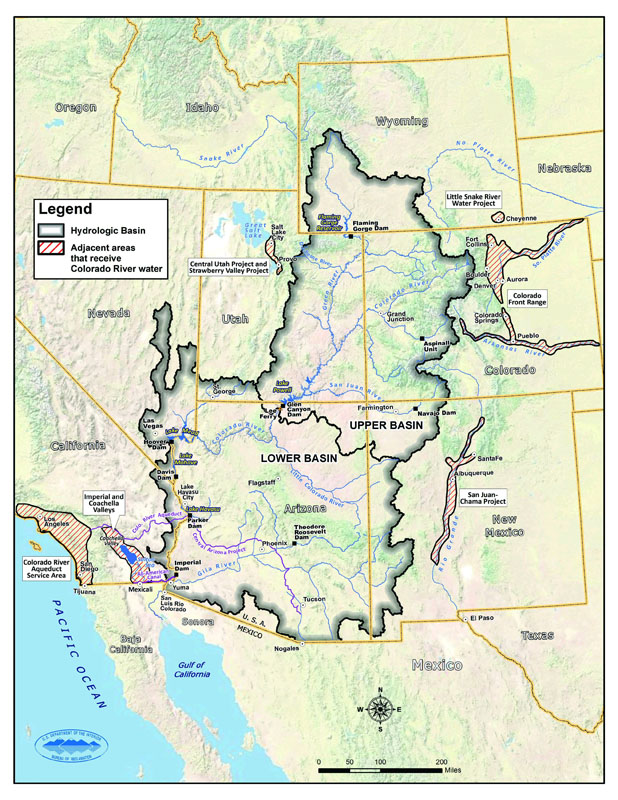
WASHINGTON, D.C. – Secretary of the Interior Ken Salazar today announced the release of a study – authorized by Congress and jointly funded and prepared by the Bureau of Reclamation and the seven Colorado River Basin states – that projects water supply and demand imbalances throughout the Colorado River Basin and adjacent areas over the next 50 years. The Colorado River Basin Water Supply and Demand Study, the first of its kind, also includes a wide array of adaptation and mitigation strategies proposed by stakeholders and the public to address the projected imbalances.

The average imbalance in future supply and demand is projected to be greater than 3.2 million acre-feet by 2060, according to the study. One acre-foot of water is approximately the amount of water used by a single household in a year. The study projects that the largest increase in demand will come from municipal and industrial users, owing to population growth. The Colorado River Basin currently provides water to some 40 million people, and the study estimates that this number could nearly double to approximately 76.5 million people by 2060, under a rapid growth scenario.

“There’s no silver bullet to solve the imbalance between the demand for water and the supply in the Colorado River Basin over the next 50 years – rather, it’s going to take diligent planning and collaboration from all stakeholders to identify and move forward with practical solutions,” said Secretary Salazar. “Water is the lifeblood of our communities, and this study provides a solid platform to explore actions we can take toward a sustainable water future. While not all of the proposals included in the study are feasible, they underscore the broad interest in finding a comprehensive set of solutions.”

Authorized by the 2009 SECURE Water Act, the study analyzes future water supply and demand scenarios based on factors such as projected changes in climate and varying levels of growth in communities, agriculture and business in the seven Colorado River Basin states of Arizona, California, Colorado, New Mexico, Nevada, Utah, and Wyoming.

The study includes over 150 proposals from study participants, stakeholders and the public that represent a wide range of potential options to resolve supply and demand imbalances. Proposals include increasing water supply through reuse or desalinization methods, and reducing demand through increased conservation and efficiency efforts. The scope of the study does not include a decision as to how future imbalances should or will be addressed. Reclamation intends to work with stakeholders to explore in-basin strategies, rather than proposals – such as major trans-basin conveyance systems – that are not considered cost effective or practical.

“This study is one of a number of ongoing basin studies that Reclamation is undertaking through Interior’s WaterSMART Program,” said Assistant Secretary for Water and Science Anne Castle. “These analyses pave the way for stakeholders in each basin to come together and determine their own water destiny. This study is a call to action, and we look forward to continuing this collaborative approach as we discuss next steps.”

WaterSMART is Interior’s sustainable water initiative and focuses on using the best available science to improve water conservation and help water-resource managers identify strategies to narrow the gap between supply and demand. The WaterSMART program includes Reclamation’s Water and Energy Efficiency grants, Title XVI Reclamation and Recycling projects, and USGS’s Water Availability and Use Initiative.”This study brings important facts and new information to the table so that we can better focus on solutions that are cost effective, practical and viable” said Bureau of Reclamation Commissioner Mike Connor. “We know that no single option will be enough to overcome the supply and demand gap, and this study provides a strong technical foundation to inform our discussions as we look to the future.”

Spanning parts of the seven states, the Colorado River Basin is one of the most critical sources of water in the western United States. The Colorado River and its tributaries provide water to about 40 million people for municipal use; supply water used to irrigate nearly 4 million acres of land, and is also the lifeblood for at least 22 Native American tribes, 7 National Wildlife Refuges, 4 National Recreation Areas, and 11 National Parks. Hydropower facilities along the Colorado River provide more than 4,200 megawatts of generating capacity, helping meet the power needs of the West.

Throughout the course of the three-year study, eight interim reports were published to reflect technical developments and public input. Public comments are encouraged on the final study over the next 90 days; comments will be summarized and posted to the website for consideration in future basin planning activities.

The full study – including a discussion of the methodologies and levels of uncertainty – is available at http://www.usbr.gov/lc/region/programs/crbstudy.html.

November 14 Water/Climate Briefing

Dynamics of Water in Urban Ecosystems: Effluent for the Environment

The reuse of effluent, otherwise known as reclaimed or recycled water, is becoming more and more of a commodity as water resource manager’s deal with tightening water budgets. It has many uses including groundwater recharge, cooling for industrial uses and irrigation for crops, public parks and golf courses. Now, it is even being considered as a drinking water supply in places using groundwater recharge/recovery or “toilet-to-tap” technology.

With its many beneficial uses possibly one of the most important is its utilization to support natural environments. Across the country, water that was once considered a nuisance is now being sought after for environmental stream flows and projects such as the Tres Rios wetlands in Phoenix and the Sweetwater Wetlands in Tucson, both of which create wildlife habitat using effluent.

Join us in a discussion on November 14, 2012, focused on the collaboration, competition, and policy implications of the use of “effluent for the environment.”

Panelists

Peter Fox, Ph.D., Professor, ASU School of Sustainable Engineering and the Built Environment
Tom Hildebrandt, Wildlife Program Manager (retired), AZ Game & Fish, Central Arizona Regions
Bruce Prior, Hydrologist, City of Tucson Water Department
Robert F. Upham, P.E., Project Manager, Water Resources Division, City of Phoenix

When

Wednesday, November 14, 2012, 12:00–1:30 p.m.
Lunch will be served. Please RSVP to: Sarah.Jones.2@asu.edu

Location

Decision Center for a Desert City, 21 East 6th Street, Suite 126B, Tempe [Map]

New Arizona Indicators Policy Points

Arizona Indicators, a project managed by ASU’s Morrison Institute for Public Policy, has just published a new Policy Points by DCDC research analyst, Sally Wittlinger. Sally’s Policy Point is entitled, “How Will the Current Drought Affect Our Future Water Supply?”

This Policy Points provides a clear, succinct overview of the status of Arizona’s water supply and what the current drought really means for water availability. Both the effect of climate change on our future water supply and the size of the population that will need to share in that supply are uncertainties that water planners must consider when making decisions regarding our future. We have options, but we have to be sure that we use water efficiently to meet our urban, agricultural, and environmental needs.

Read the entire Policy Points at the Arizona Indicators website.

Decision Center for a Desert City, at the request of the ASU President’s Office, has been contributing to the Sustainability indicators since the inception of the project. These indicators currently are housed in four categories: Air Quality, Water Quality, Urban Heat Island, and Energy. DCDC also now contributes to the three sustainability-related indicator categories on the Transportation tab, Travel Time and Congestion, Commuters’ Mode of Travel, and Public Transportation. Data for these indicators are collected from various public sources and are presented in a way that makes them accessible to the general public.

For more information about DCDC’s involvement in the Arizona Indicators project, visit the DCDC website.