In a new publication, DCDC authors Kelli L. Larson, Dave D. White, Patricia Gober and Amber Wutich examine the complexities, uncertainties, and decision processes for water sustainability and urban adaptation to climate change in the Phoenix, Arizona region in Decision-Making under Uncertainty for Water Sustainability and Urban Climate Change Adaptation.
Complexities and uncertainties surrounding urbanization and climate change complicate water resource sustainability. Although research has examined various aspects of complex water systems, including uncertainties, relatively few attempts have been made to synthesize research findings in particular contexts.
The authors integrate over a decade of research conducted by Arizona State University’s Decision Center for a Desert City (DCDC). DCDC is a boundary organization that conducts research in collaboration with policy makers, with the goal of informing decision-making under uncertainty.
Their results highlight: the counterintuitive, non-linear, and competing relationships in human–environment dynamics; the myriad uncertainties in climatic, scientific, political, and other domains of knowledge and practice; and, the social learning that has occurred across science and policy spheres.
Finally, they reflect on how our interdisciplinary research and boundary organization has evolved over time to enhance adaptive and sustainable governance in the face of complex system dynamics.
Citation: Larson, K.L.; White, D.D.; Gober, P.; Wutich, A. Decision-Making under Uncertainty for Water Sustainability and Urban Climate Change Adaptation. Sustainability 2015, 7, 14761-14784.
The Authors
Kelli L. Larson, School of Geographical Sciences and Urban Planning and School of Sustainability, Arizona State University
Dave D. White, School of Community Resources and Development, Arizona State University
Patricia Gober, School of Geographical Sciences and Urban Planning, Arizona State University
Amber Wutich, School of Human Evolution and Social Change, Arizona State University
As uncertainty about water access in the West increases, the Decision Center for a Desert City at Arizona State University is connecting policymakers with research to make better resource management decisions for the future.
The DCDC has been conducting climate and water research in the Phoenix metropolitan area since 2004. Now, thanks to a $4.5 million grant from the National Science Foundation — the third made to DCDC by the NSF since its founding — the DCDC will expand its work beyond Arizona to other cities dependent on the Colorado River Basin in Colorado, Nevada and California.
The funding comes from the NSF’s Decision Making Under Uncertainty program. The DCDC and other groups receiving this funding aim to increase information available to decision-makers by developing analytic tools, facilitating interaction with researchers and bringing decision-makers together.
“We’re a boundary organization,” says Ray Quay, director of stakeholder relations at DCDC. “We try to bring science into public policy.” In Phoenix, the DCDC does this in part through collaborative research. Using satellite imagery, DCDC helped the city better understand how changes in water demand over time are related to changes in land use. The DCDC will now work to identify similar opportunities in Las Vegas and Denver, the first cities that will benefit from the expansion.
The DCDC also hosts “neutral convenings” in the Phoenix area where policymakers come together to discuss environmental concerns and solutions — topics that can ignite heated arguments in some places — and learn from one another in an uncharged space. For one such meeting, the DCDC brought together water managers from across the region with different viewpoints to discuss research and decision-making strategies about a potentially divisive issue: How should cities respond if an extended drought requires them to shift from using surface water to groundwater, what DCDC calls the “All Straws Sucking Scenario”?
“Arizona water is highly regulated, and water utilities are uncomfortable being open in discussion when an agency that regulates them is part of the discussion,” says Quay. DCDC was perceived to be an unbiased host.
Expanding into Denver and Las Vegas, the DCDC will conduct surveys of the general public and water managers to identify problems, areas where agencies feel they have answers to share and topics requiring regional discussion.
One of the organization’s primary research and education tools is WaterSim 5.0, which estimates water supply and demand for Phoenix and the 32 cities in its metropolitan area. Users can control as many as 53 inputs, including river runoff, percentage of wastewater reclaimed, population growth, and per capita water use, and then see the impacts of these decisions on water supply, water demand, and a variety of sustainability indicators.
David Sampson, WaterSim’s lead developer, says the tool was originally intended to help water providers with planning, but that the program isn’t yet perfectly suited for their needs. “The nice thing about WaterSim is that it’s an aggregate of all the cities,” says Sampson, “but the cities of course only work within their own [boundaries].” One goal with this round of NSF funding is to allow finer spatial parsing of WaterSim’s region, allowing water providers and managers to make finer-grain decisions. Sampson is also working to integrate a groundwater model that is based on supply rather than credits.
At present, WaterSim is primarily a tool for education and outreach, and the DCDC has also created a less complex educational model, an online version that has just five inputs. WaterSim can be used “to tell stories,” says Quay, by leading members of the public and elected officials in a guided discussion using the interface. “One story might be that there is no silver bullet.” As people better understand the complexity of the system, supplies and management, they see that “there really is no one solution under the uncertainty of climate change and drought,” says Quay.
Another story is that “it’s not just the system that’s complicated, but how people use the system and benefit from the system that’s complicated as well,” says Quay. Farmers value water differently than manufacturers, who value water differently than homeowners or environmentalists. “They all have different perspectives on what sustainability means,” says Quay. “Using this tool we can show how to maximize sustainability from all of these viewpoints, but that there’s no way to maximize sustainability for all of these viewpoints.”
Quay says it’s unclear how the DCDC will extend its modeling capacity to include other Colorado River Basin cities. It will depend on whether different regions will see a benefit, he says, and what types of modeling systems they already use.
The DCDC is working to create more educational modeling tools, though. Sampson is developing a scaled-down water supply and demand simulation for a traveling Smithsonian exhibition that will visit all 50 states in the next five years. Sampson and the DCDC will create a model for every state, with elements that look at climate change and human use.
“People can learn a little more about water decisions and water use and how that relates to climate change,” says Sampson. “Every state has a different challenge.”
Source:
By Jen Kinney
September 24, 2015 New City – The Works
The Works is made possible with the support of the Surdna Foundation.
Farmers in arid central Arizona have always faced a formidable climatic challenge. The region around Phoenix receives a scant fraction of the annual rainfall needed to irrigate traditional crops like alfalfa and cotton, and summertime high temperatures make it the hottest metropolitan area in the United States. Nevertheless, infrastructure improvements and policy have made both booming urban development and exceptional agricultural yields possible in the Phoenix area over the last few decades. These developments, however, have also buffered farmers from directly experiencing signals of climate change.
This may now be changing. The severe drought conditions that have affected the West since the turn of the century have called into question the long-term reliability of the Colorado River system, which has underwritten regional growth. Some irrigation district managers are now reexamining expectations about how much water they can deliver to agricultural water users. For instance, one irrigation district manager said, “We have to plan for the future. If we know we’re going to have a dry year and I know the reservoirs are really low, if we think there’s going to be a shortage then we’ve got to do something, to either get more wells in or let the farmers know. We’re probably their best source of information.”
Monitoring future supply
Understanding how farmers and irrigation district managers use climate information has been a priority in research supported by the National Oceanic and Atmospheric Administration (NOAA) at Arizona State University, in collaboration with the University of Arizona Cooperative Extension Service. Irrigation district managers cannot rely solely on local forecasts for their decision making: some monitor stream gauges located on Colorado River tributaries more than a thousand stream-miles away. Many managers keep track of how policy decisions about reservoir management, energy production, and inter-sector water allocation may affect the quantity, quality, and cost of the water they access. An irrigation district manager explains, “We use NOAA, I use the ski reports a lot from Colorado because you can get all the averages and see what it’s done in the past week so you know if you’re gaining or losing snow.” In turn, these managers try to pass on this information to users, including farmers, whether through official channels or during informal meetings on ditch banks and in coffee shops.
Additional adaptation strategies
Improved information is only one part of the adaptation puzzle. Irrigation district managers are now thinking creatively about how to ensure that infrastructure is maintained to allow flexible adjustments between groundwater and surface water sources. During a water shortage, limitations on groundwater pumping capacity can be just as challenging as getting enough water for crops. Depending on the ownership and control of groundwater wells within a district, managers can strategize by running only the most efficient wells, ensuring that pumps in the same location aren’t running at the same time, and by making substitutions between local water allotments to keep operational costs even. Some are also engaging directly with water suppliers and utilities outside the region to ensure reliable and affordable access in the future. For the first time, in 2015, some central Arizona irrigation districts are volunteering to forgo a portion of their water allotment in the reservoir behind Hoover Dam as part of a multi-state experiment in extreme drought operations. Others have forgone groundwater pumping through water banking agreements.
Urbanization, competition for water and land, and volatility in agricultural policy, as well as energy and commodity prices, challenge efforts to further innovate in water practices. While farmers hope to continue contributing to the rural economy, they worry that their long-term viability will depend as much on how state and city managers value their presence and resource needs as it does on their own capacities to proactively respond to rapidly changing water supplies.
Working with the farming community
Farmers in this region come from a community shaped by generations of coping with extreme heat, and they are experiencing an extended drought. They are also literally losing ground to urban development. Many are apt to focus on what is familiar and near, depending upon strategies they have used in the past. For example, a third-generation farmer in the area explained, “The standing water table depth when my dad bought this farm was about 20 feet, and the last time we measured it was 25 feet to the water, so the depth to the water is very shallow. Right off the bat the thing that it tells you is that we are not pumping fossil water, it absolutely is rechargeable.” Farmers’ knowledge and experience comprise rich, site-specific detail, on a different scale and often with contrary implications compared to observations made by policymakers and researchers. Effective policy dialogs need to respectfully bridge these differences.
The past success of efforts to secure and diversify water sources may have created new, more obscure, vulnerabilities and interdependencies. Like generations before them, farmers today are independent entrepreneurs. Nevertheless, the outcomes of individuals’ decisions have never been more contingent upon each other: from maintaining local irrigation ditches and district wells, to balancing demands from major interstate water and energy generation infrastructure, farmers are not only needing to collaborate with each other, but also with others representing urban, energy, and ecological interests in Arizona and in neighboring states. It will take a continuing effort by all interested parties in central Arizona to learn to accommodate uncertainties in water supply and tradeoffs in water use decisions into the future.
Source: U.S. Climate Resilience Toolkit
Story Credit:
Skaidra Smith-Heisters and Hallie Eakin, Arizona State University.
Banner Image Credit:
Hallie Eakin, Arizona State University
As the climate in the Southwest becomes hotter and drier, water will become an ever more precious resource, demanded by people with competing interests.
Ranchers and farmers could see their livelihoods threatened by urban areas that scoop up more water as their populations swell. Shrinking lakes could mean fewer tourists and loss of jobs. So who wins?
An Arizona State University team has received a three-year grant to study how people collaborate — or not — on the complex decision of who gets how much water, and how using technology might affect their reactions. Empathy is the crux of the study. The researchers want to see whether participants can be coaxed into relinquishing power for the greater good.
The National Science Foundation awarded $449,000 to the interdisciplinary group in July. The scholars are from the School of Public Affairs, the W. P. Carey School of Business, the School of Social Work and the Decision Center for a Desert City. Erik Johnston, an associate professor in the School of Public Affairs and director of the Center for Policy Informatics, is the principal investigator.
About 300 students have taken part in the study so far, he said, and about 500 more will participate over the next three years. They interact individually or on teams using computers, with the researchers changing different aspects of the role playing to see what promotes empathy. Each session takes about 90 minutes. “There are a lot of values at play all the time, which is the heart of governance,” Johnston said.
The digital platform that delivers the interactive modules was created by Johnston and Ajay Vinze, associate dean for international programs at the W. P. Carey School of Business. Vinze, who studies the role of technology in human interaction, is a co-principal investigator for the study and also associate vice provost for graduate education at ASU.
They then paired their platform with the WaterSim estimator tool created by the Decision Center for a Desert City (DCDC), which set the stage for this work. “We created a mobile version of WaterSim that uses their underlying logic and their scientific reasoning behind it. When people are allocated water choices, the consequences they see have been scientifically derived from the research at DCDC,” Johnston said.
Water-use policy is a good example for interdisciplinary study, Vinze said. “These are complex and difficult challenges to address,” Vinze said. “In order to solve the big problems of the world, we need to look at them in an interdisciplinary way.”
Empathy is measured at the beginning and end of the sessions using a survey developed by Elizabeth Segal, a professor in the School of Social Work and another co-principal investigator. Vinze said that the interplay of empathy and technology is key. “Empathy is not a new concept, but the notion of ‘how does empathy change if I look through the lens of technology?’ is new,” he said.
Vinze and Johnston had already done some preliminary research on that. “If you understand where the other person is coming from, you’re likely to see the other person empathetically. If you feel more empathy, you’re more likely to put your own resources at risk for an outcome,” Johnston said. “We thought ‘This is simple. We’ll get them to walk a mile in another’s shoes.’
“But it wasn’t that easy. Everything we tried made the situation worse, with lower empathy outcomes and less likelihood of collaboration. “It’s very complex.”
The study participants play differing roles. For example, subjects might be a big city negotiating with a small city, with different levels of political clout. The game poses various scenarios for water usage, considering effects on variables such as jobs, sustainability, food scarcity and quality of life. “When the undergrads played, they got rid of all the pools. But they don’t look at the misery aspect of that,” Johnston said.
The model computes all the dimensions so participants can see the system-wide consequences of their decisions – a factor that could have profound real-life value, Johnston said. “There’s not a clean answer,” he said. “It helps to focus their attention on where there are conflicts: Do we have more sustainability in the future or more jobs now? Do we invest in food security or community pools? “They get to see the trade-offs between those decisions.”
Johnston said the team hopes that real policymakers can eventually use the models, which would put their decisions to the test. “This is an argument that we’ve been making for a while: What is the notion of professional use of data when everyone can find data that supports their own viewpoint?”
In the grips of long-term drought, the Colorado River Basin and the cities that rely on its water face unprecedented challenges and significant uncertainty with a warming climate and large-scale land-use change. They are developing new water-resource policies for a future of increasing uncertainty.
Now, water managers and decision makers of cities of the Colorado River Basin will be able to take greater advantage of Arizona State University’s Decision Center for a Desert City (DCDC) thanks to a new $4.5 million National Science Foundation award.
The four-year award, the third made to DCDC in its 10-year history, brings the total NSF investment in the center to $18 million. It will allow ASU to expand the geographic scope of DCDC’s work beyond Phoenix to include cities dependent upon Colorado River water in states like Colorado, Nevada and California to explore transformational changes that will be necessary to sustain water supplies well into the future.
Decision Center for a Desert City, which is a research unit of the Julie Ann Wrigley Global Institute of Sustainability at ASU, conducts climate, water and decision research, and it develops innovative tools to bridge the boundary between scientists and decision makers.
DCDC researchers work closely with the Decision Theater Network to engage stakeholders using models and simulations that visualize alternative futures and to promote dialogue about sustainability solutions.
“It is an unprecedented time to conduct this type of use-inspired research for the Colorado River Basin region,” said Dave White, director of Decision Center for a Desert City. “It comes with a greater sense of urgency and a greater sense of understanding of the scale and scope of the changes that are likely necessary to transition the cities and the region into a more sustainable state over the next several decades.”
The work of the center’s researchers is interdisciplinary, integrated across areas such as hydrology, water science, economics, anthropology, geography, policy and sustainability, White explained. A primary tool developed by DCDC is WaterSim 5.0, a “systems dynamics model” that can help drought-ravaged cities anticipate a range of possible future conditions and build capacity for sustainable water-resource management and climate adaptation. David Sampson, a research scientist with the center, developed the model.
WaterSim’s power lies in its ability to bring together the multifaceted issues faced by water users and suppliers and play out scenarios so to provide a clearer picture of what the future might hold. Until now WaterSim had integrated the needs and policies of the 33 cities that make up the Phoenix metropolitan area.
“At the center of everything is the question, ‘How do we make better decisions about the future and managing our resources in a sustainable way?’” said White, an associate professor in the School of Community Resources and Development in ASU’s College of Public Service and Community Solutions. To do that the center will conduct research across four integrated project areas.
One integrated project area will focus on the biophysical process models that simulate climate change, urbanization, land use and hydrological processes in the Colorado River Basin to produce a set of climate and land-use scenarios. The second integrated project area will focus on models of the social, economic and institutional considerations of the region, the third will focus on systems modeling and simulations and the fourth integrated project area will develop an inventory of transformational solutions to water governance.
The integrated project area teams will be led by co-investigators Kelli Larson (School of Geographical Sciences and Urban Planning and School of Sustainability), Enrique Vivoni (School of Earth and Space Exploration), Michael Hanemann (W. P. Carey School of Business) and Amber Wutich (School of Human Evolution and Social Change).
“We are building on our strengths — water-resource management and climate-change adaptation — which we have been doing for 10 years now at DCDC,” White said. “Understanding how water is developed, supplied, delivered and managed and how those activities will be affected by climate change is central. We are building on the use of WaterSim and simulation modeling as a tool for science and policy integration and a tool for stakeholder engagement.”
Ray Quay, director of stakeholder relations at DCDC, leads the center’s efforts to connect university science with policy and decision-making.
White said a goal of the new NSF award is to explore alternatives that need to be considered to make the Colorado River Basin region more sustainable in an uncertain future.
“There is a growing sense that there needs to be a greater discussion about trade-offs,” he said. “The current system is set up based on legacy decisions, and we want to critically evaluate them. We want to inform a science-based public discourse about the situation as opposed to just accepting this as the way it is.”
Through the expanded use of DCDC and WaterSim, researchers will build a suite of robust alternatives for the cities that rely on Colorado River water to strengthen their positions and not be as vulnerable to unforeseen change.
“We want to get not only ahead of this current drought and crisis but to use this energy and opportunity to think about the next 30 years, or the next 100 years,” White said.
Skip Derra
skip.derra@asu.edu
480-965-4823
Media Relations
In the Southwestern United States, the agricultural sector has historically been the largest single demand for water and energy.
Agriculture is vulnerable to climate change because of the direct dependence of farm production on rainfall, streamflow, and snowpack. In central Arizona and elsewhere in the West, irrigation and large-scale water storage and conveyance infrastructure (e.g., dams, canals) introduce additional complexity to the policy context.
While irrigated agriculture in central Arizona has been protected from year-to-year variability in precipitation through large investments in water infrastructure—such as the Hoover and Roosevelt dams and the Central Arizona Project aqueduct—the prospect of long-term shortage conditions on the Colorado River, or prolonged local drought, throw the future security of the agricultural water supply into question.
As central Arizona agriculture has become increasingly dependent on surface water infrastructure, groundwater infrastructure maintenance has often been put on hold, limiting the flexibility of response to surface water availability.
Farmers’ choices are affected not only by water rights and access, but also by increased pumping costs due to rising energy prices and insecurity of land tenure. Many farmers are now disincentivized from making irrigation efficiency improvements because they hold short-term leases on land owned by urban developers.
In the Phoenix metro area, a slowdown in the urban economy (especially housing construction) happened at the same time as an upsurge in farm commodity prices, shifting opportunity for expansion and associated water demand back to the agricultural sector.
Global increases in commodity prices underscore a growing concern that farmland is being lost while global food and fiber demands are still increasing.
Although market signals are critical in central Arizona farmers’ decisions, uncertainties and interdependencies potentially impede planning and responsiveness in the agricultural sector.
Authors
Hallie Eakin, Associate Professor, School of Sustainability, ASU
Rimjhim Aggarwal, Associate Professor, School of Sustainability, ASU
Abigail York, Associate Professor, School of Human Evolution and Social Change, ASU
Skaidra Smith-Heisters, Graduate Research Assistant, School of Human Evolution and Social Change and Decision Center for a Desert City, ASU
The patroller stopped his water district truck and grabbed his camcorder.
“Here we go,” he said, sliding from the cab and pointing his lens at the fine spray of water and rainbow rising from pop-up sprinklers on the lawn of a low-slung ranch home.
“Thursday,” he spoke, recording the day as evidence. No watering allowed on Thursdays.
Welcome to the future, where every drop of Colorado River water is guarded and squeezed. Only here, in the city that gets 90 percent of its water from the fickle and fading river, the future is now.
The vast and highly urbanized Southwest, built on the promise of a bountiful river propped up by monumental dams, is up against its limits. Already tapped beyond its supply, the river is now threatened by a warming climate that shrinks its alpine source.
To support fast-growing urban populations in a time of dwindling supply, the Southwest is due for rapid and revolutionary changes.
A region that uses two-thirds of its water outdoors, and mostly for agriculture, will have to find ways of sharing and boosting efficiency — a shift that many experts believe will mean city dwellers paying to upgrade rural irrigation systems.
Cities such as Phoenix and Las Vegas, which have reduced their per-person water usage through better landscaping and appliances, will have to do better. They lag behind Los Angeles, whose growing population, by necessity, uses no more water than it did 40 years ago.
Water suppliers from Denver to San Diego will spend billions of dollars to squeeze more out of each drop, and to clean and use wastewater and salt water. It means a future of higher water bills, further promoting conservation.
Erik Johnston, Center for Policy Informatics, Arizona State University Dara Wald, Center for Policy Informatics and Decision Center for a Desert City, Arizona State University
For the past six years we have worked with the NSF-supported Decision Center for a Desert City at Arizona State University to create educational experiences using the WaterSim Platform. This model, based on water demand and supply in the Phoenix Metropolitan area, was developed to help stakeholders deliberate on and explore the consequences of urban water planning decisions in central Arizona. The user-interface allows participants to adjust various parameters—population growth, climate change, agricultural water use, urban development, and residential water use—and receive instant feedback on their decisions.
We believe that only through experiencing the realities of complexity, uncertainty and human behavior, can modern public administration challenges be understood.
In teaching game theory to students in the School of Public Affairs, we describe the concepts of “mutual best responses” and “dominant strategies,” but it is only when the students participate in a 1-2 hour game theory tournament, does the nuance of strategic interaction hit home.
During the 20-30 rounds of games—where Skittles are the currency—students play in pairs, in groups, single rounds and repeated interactions, and in cooperative and not-so-cooperative arrangements. In response to game play, the most common phrase we hear is, “That is not how they were supposed to behave.” Within minutes it becomes clear that, as in real-life public administration challenges, knowledge is useful, but the essential component is experience, particularly multiple experiences with varying outcomes. However, there are limits to the use of Skittles.
To address more sophisticated challenges, we have developed an interactive, collaborative simulation to provide an environment for students to experience the challenges of modern public administration, including complex systems that illustrate the interplay of policy, infrastructure, climate uncertainty, and multiple interdependent stakeholders.
Because water supply and demand face equally uncertain futures, a strategy that considers their relationship and anticipates a range of possible future scenarios for these two fundamental aspects of water use might be the wisest approach for water resource managers.
Abstract
Uncertainty has been a driving factor in water resource planning for several decades, particularly in arid regions and in those with a high degree of interannual variability in precipitation.
In the last few decades, anticipatory governance has emerged as an approach for planning under conditions of high uncertainty.
In shifting from a predict-and-plan approach, water resource managers are anticipating a wide range of futures, developing response strategies, and adapting to anticipated changes as needed.
The uncertainty of water supply has been the primary focus of such efforts primarily because of the potential for long-term drought and climate change.
Until recently, water-demand estimating and forecasting have been viewed with greater certainty than water supply, with a focus on revenue projections, infrastructure capacity planning, and how demand can be reduced in the long term and quickly during drought.
However, water-demand estimating and forecasting have high levels of uncertainty, particularly in the longer time frame, and thus can also benefit from anticipatory governance. Integrated water resource planning is an approach that brings the uncertainty of water demand and supply into a common anticipatory governance framework.
Congratulations to DCDC researcher, Enrique Vivoni, who was awarded a Leopold Leadership Fellowship!
Arizona State University hydrologist Enrique Vivoni has been awarded a Leopold Leadership Fellowship –– a prominent North American program focused on communicating environmental science to a wide audience.
He becomes one of 20 Leopold Leadership Fellows for 2015 selected for their outstanding scientific qualifications, demonstrated leadership ability, and strong interest in sharing their knowledge beyond traditional academic audiences.
The Fellows will receive two weeks of intensive communication and leadership training in how to deliver information about their research to journalists, policymakers, business leaders and the public.
Vivoni is an associate professor in the School of Earth and Space Exploration and the School of Sustainable Engineering and the Built Environment, one of ASU’s Ira A. Fulton Schools of Engineering. He is internationally recognized in the fields of distributed hydrologic modeling, ecohydrology of semi-arid regions, North American monsoon studies and integration of engineering tools for advancing hydrologic science.
Water in the southwestern United States and northern Mexico is a contentious issue that traverses disciplinary boundaries. Vivoni’s research activities focus on the intersection of hydrology and its allied disciplines – ecology, meteorology and geomorphology – for improving understanding of water resources in this region.
A hallmark of his research achievements has been the collaborative studies of the shared water resources between the U.S. and Mexico.
“I am honored to be chosen as a Leopold Fellow and I look forward to serving as a focal point for water resources issues in the southwestern U.S. and northern Mexico,” Vivoni said. “The leadership skills developed through the Leopold Leadership program will be useful for addressing societal needs related to water resources sustainability.”
The Leopold Leadership Program, based at Stanford University’s Woods Institute for the Environment, is a competitive fellowship for outstanding academic environmental scientists who are actively engaged in outreach to decision-makers and the public about their work. Each year, the program selects up to 20 midcareer academic environmental scientists as fellows.
The program was founded in 1998 to fill a critical gap in environmental decision-making: providing the best scientific knowledge to government, nonprofit and business leaders, and the public, to further the development of sustainable policies and practices.
The list of 2015 Fellows is below, and more information about the program is available at Leopold Leadership.


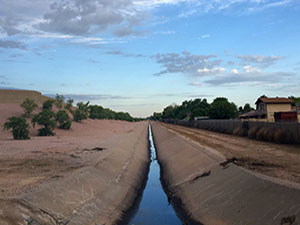 Complexities and uncertainties surrounding urbanization and climate change complicate water resource sustainability. Although research has examined various aspects of complex water systems, including uncertainties, relatively few attempts have been made to synthesize research findings in particular contexts.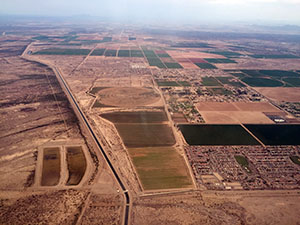
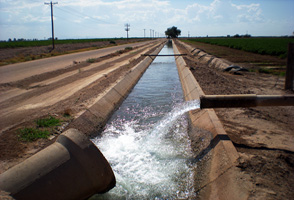

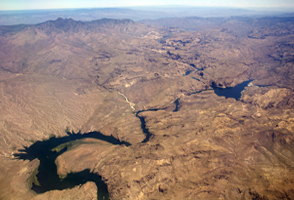

 Uncertainty has been a driving factor in water resource planning for several decades, particularly in arid regions and in those with a high degree of interannual variability in precipitation.
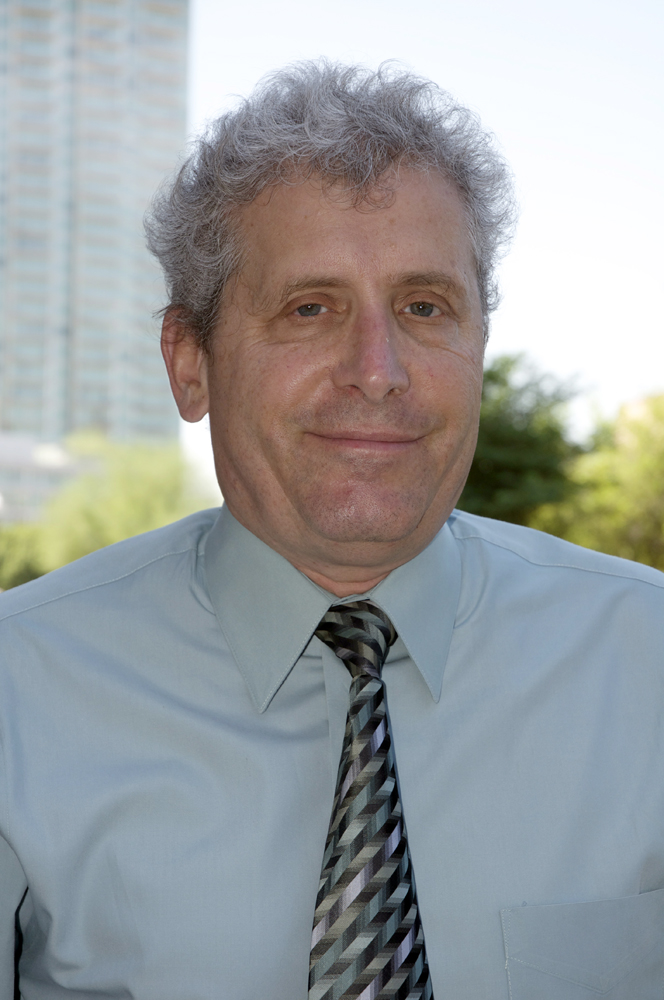
 Arizona State University hydrologist Enrique Vivoni has been awarded a Leopold Leadership Fellowship –– a prominent North American program focused on communicating environmental science to a wide audience.